
Tillamook Youth Release Paths
Tillamook Youth Correctional Facility is secure Oregon Youth Authority custody. A young person may move to another OYA setting, enter a transitional placement, begin an authorized community phase, start juvenile parole or probation, or discharge. Those events are not interchangeable. A move between secure facilities does not end custody. Nor does participation in a community activity prove that the youth has been discharged.
OYA manages the movement, case plan, parole or probation, and community transition. Authorized family members should work with the case coordinator or living-unit channel. A lawful court record may help identify the committing authority, but juvenile and protected case records can be restricted. The adult Tillamook inmate list is not a historical search for this youth facility.
| Event | Status | Proper channel |
|---|---|---|
| OYA transfer | Secure custody continues | Authorized OYA case contact |
| Transition program | May remain close custody | OYA case team |
| Juvenile parole or probation | Community status with supervision | Assigned OYA or juvenile officer |
| Discharge | Authority ends as formally recorded | OYA and lawful court channel |
Confirm Tillamook Youth Release
Begin with the agency, not an adult inmate search. Determine whether the young person is in OYA custody and whether the commitment arose through juvenile or adult court. A youth committed through adult court may remain at OYA until the applicable age, so age alone does not identify the correct public record.
- Confirm the full facility name and that OYA is the custodian.
- Use the young person's assigned case coordinator or living-unit contact when authorized.
- Ask whether the reported event is a transfer, transition step, parole or probation status, or discharge.
- Use VISOR only as a state status or notification clue, not as an official youth release certificate.
- Consult a lawful court channel for the order when access is allowed.
- Accept that confidentiality may prevent public confirmation and do not infer release from silence.
The adult Tillamook County release search helps distinguish county, state adult, and youth systems, but it does not override OYA privacy rules. Public nonappearance is normal for some protected records. Family members without an established case contact should call the facility and ask how an authorized inquiry is routed.
Tillamook Youth Records Contact
The facility's case coordinator and living-unit channels are the correct starting point for an authorized family inquiry. General staff can explain routing but may be unable to confirm private facts to an unrelated caller. Asking for the process is more realistic than asking for an adult-style public release list.
Tillamook Youth Correctional Facility
6700 Officer Row
Tillamook, OR 97141-8903
General phone: 503-842-2565
Fax: 503-842-4918
Business hours: Monday through Friday, 8 a.m. to 4 p.m.
Operator: Oregon Youth Authority
When calling, provide only the information needed to locate the proper staff contact. Explain the relationship and authority to receive information. Ask which office can address the youth's current placement or documented transition. Staff may require identity verification, consent, or another lawful basis before sharing details.
A formal request should name the exact public record and date range. Oregon public-record law does not erase youth-confidentiality statutes, sealed-case rules, medical privacy, or victim protections. If part of a record can be released, a requester may ask for the segregable public part and a written basis for material that is withheld.
Tillamook Youth Secure Custody
OYA operates Tillamook Youth Correctional Facility as a secure youth correctional site. It can house up to 32 youth and provides treatment, education, and services. These facts define a youth-custody setting. They do not turn its records into adult jail records or make every placement detail public.
The committing path can matter. Some young people are committed through juvenile proceedings, while some who came through adult court can remain in OYA placement. The applicable order, case authority, assigned case staff, and confidentiality rules determine what can be confirmed. The county Sheriff's jail and ODOC offender search are separate adult systems.
- Secure custody
- A controlled correctional placement under OYA authority.
- Transition
- A planned move toward community return that may still include custody.
- Juvenile parole
- Community supervision under the applicable youth authority.
- Discharge
- The formal end of the authority or status identified in the record.
Tillamook Youth Custody Facilities
Tillamook County has two distinct OYA sites near one another. Tillamook Youth Correctional Facility is a secure correctional facility with space for up to 32 youth. Camp Tillamook Youth Transitional Facility is a separate secure transitional program with space for up to 16 youth. The second program's community-return focus does not mean its residents are already released.
This local distinction makes the exact facility name essential. A family member may hear that a youth moved to a camp or began an activity and assume custody ended. Instead, ask OYA whether the move changed the legal custody status. Age and committing authority also matter because the adult public systems do not give a full account of OYA placement.
The official Tillamook YCF page provides the source facility details shown in the capture.
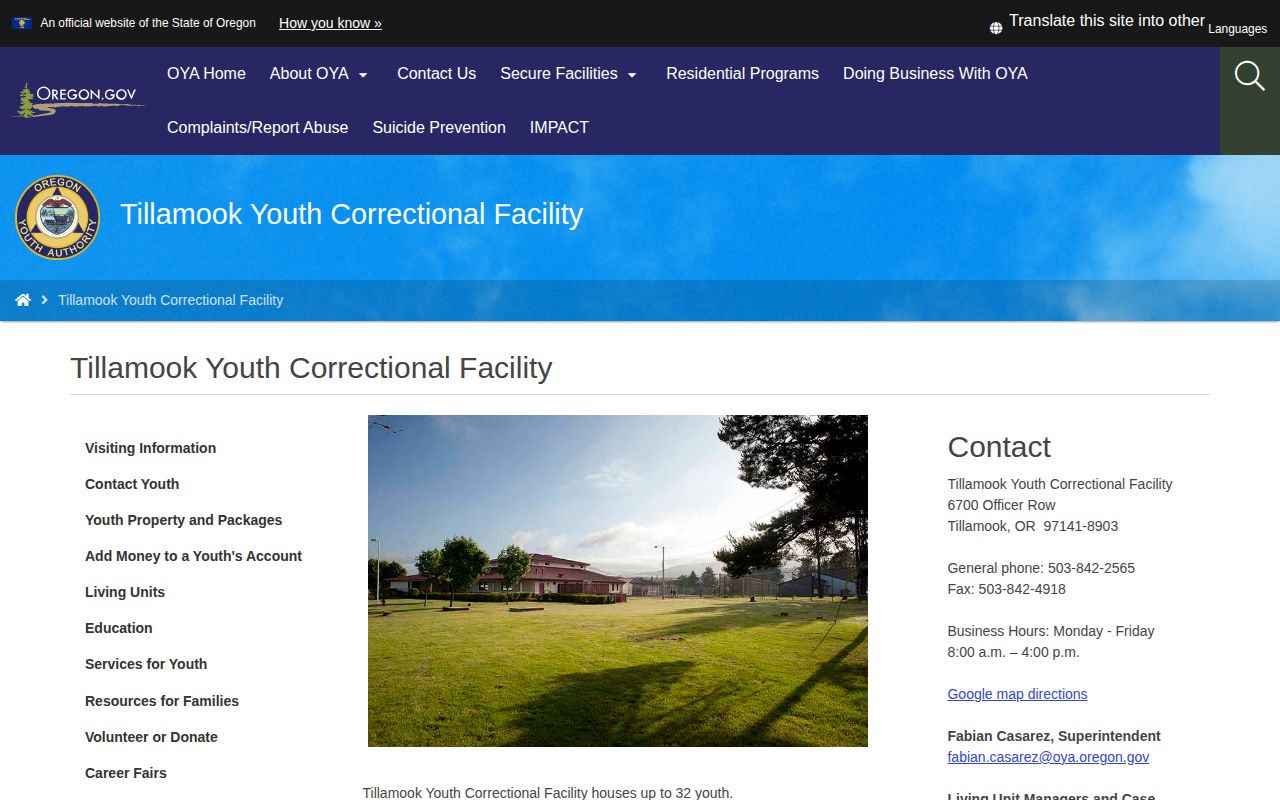
The official page confirms the OYA setting that controls authorized placement and transition questions.
Tillamook Youth Record Privacy
Juvenile, sealed, medical, victim, and other protected records may be unavailable or redacted. Oregon court guidance also treats juvenile matters as access-limited. That means a blank court search, missing adult roster entry, or limited phone response has no single meaning. It can be a normal result of lawful confidentiality.
Do not use an adult county roster to declare that a youth has left custody. Do not rely on Oregon Offender Search as a complete OYA history. VISOR works with OYA at the state level, but its data are periodically updated and not an official record. A notification can help an authorized person track an event; it does not waive privacy law or certify the full case history.
Tillamook Youth Release Records
A useful authorized record should distinguish the agency whose custody ended, the effective date, the legal authority, and any continuing supervision. Those are questions to ask, not promised fields on a public page. A court order can state what was authorized, while OYA records address the actual placement and movement.
Terms need care. A transfer keeps custody in place. A transition step prepares for return but may remain secure. Juvenile parole or probation can place the youth in the community with conditions. Discharge is the formal end described by the controlling record. Using the exact term avoids overstating what happened.
Note: Ask whether OYA authority ended or merely changed form when confirming a youth transition.
Authorized Tillamook Release Inquiry
Keep an inquiry narrow. State the youth's name, the facility, the approximate period, the relationship, and the reason authority exists to receive information. Ask for the staff member who can address placement or transition. Avoid sending private medical or victim information through a general contact channel unless staff direct that method.
If a court record is lawfully available, confirm the case location and exact document. A judgment or order may describe commitment or supervision, but it may not show the precise time a facility carried out the movement. OYA remains the key source for its custody event. No public adult search should be treated as a substitute.
Tillamook Youth Custody Boundaries
Tillamook County's custody landscape includes an adult Sheriff's jail, an adult state forest camp, and two OYA youth facilities. The nearby locations can obscure the agency line. A record from one system cannot certify a release from another. The county jail owns its booking and movement records. ODOC owns its adult prison records. OYA manages youth placement and transition records.
VISOR spans several Oregon systems and can help with status or notifications, but that broad coverage does not turn it into an official record or remove youth privacy limits. Likewise, a court order can show legal authority without proving the exact hour when OYA completed a move. Use each source for the fact it creates.
The best inquiry states the needed event without assuming its label. Ask whether secure OYA custody ended, whether another placement began, whether community supervision followed, and whether final discharge occurred. Staff can then apply the correct access rule to each fact. If the response is limited, preserve that uncertainty. A protected record should not be replaced with a guess based on an adult roster, a search-engine result, or secondhand language about someone coming home. The limits belong in the result, not outside it.