
Camp Tillamook Transition Paths
Camp Tillamook Youth Transitional Facility prepares young people for community return through treatment, education, life skills, and work-study activity. Yet OYA classifies youth transitional facilities as secure close custody. A youth can take part in an approved activity or move through a transition phase without being discharged. Physical location and legal custody are separate questions.
Possible next steps include another OYA placement, a continued secure program, an authorized community phase, juvenile parole or probation, or formal discharge. OYA and assigned case staff control those records. An adult county inmate roster does not show this program's release history, and absence from a public search does not prove that the youth returned to the community.
| Camp event | What can be concluded | Who confirms it |
|---|---|---|
| Work or study activity | Close custody may continue | Authorized OYA contact |
| Move to another OYA site | Custody continues | Case coordinator |
| Community supervision | Physical custody may end with conditions | OYA or juvenile officer |
| Final discharge | Authority ends as recorded | OYA and lawful court source |
Confirm Camp Tillamook Discharge
Use an authorized OYA route first. Identify Camp Tillamook by its full name because it sits near a separate youth correctional facility. Then establish the young person's committing authority and the caller's right to receive information. Public access may be limited even when the youth has moved.
- Verify that Camp Tillamook, not the neighboring youth correctional facility, is the placement in question.
- Contact the case coordinator, juvenile parole or probation officer, or other assigned OYA staff when authorized.
- Ask whether the event is a work activity, transfer, community transition, supervised release, or discharge.
- Use VISOR as a status or notification clue only if the person and event are available.
- Check a lawful court channel for the controlling order where access rules permit.
- Do not infer release when privacy rules prevent an answer.
The Tillamook County released inmates search distinguishes adult jail, adult prison, and youth systems. Its adult records cannot replace an OYA inquiry. A young person committed through adult court may still remain with OYA, which makes agency identification more reliable than age alone.
Camp Tillamook Records Contact
Camp staff can route an authorized family or case inquiry. A general caller should expect limits because the program serves youth and case records can be confidential. Ask who can explain the process before seeking personal facts. The proper staff member may need to verify identity, relationship, consent, or legal authority.
Camp Tillamook Youth Transitional Facility
6820 Barracks Circle
Tillamook, OR 97141-9683
Phone: 503-842-4243
Fax: 503-842-1476
Business hours: Monday through Friday, 8 a.m. to 4 p.m.
Operator: Oregon Youth Authority
For a record inquiry, name the exact event and approximate date rather than requesting an entire file. Ask for the public record, if any, that shows whether secure OYA custody ended, whether supervision began, and whether another OYA placement followed. The requested items may not all exist as one record or be open to a third party.
Oregon public-record law permits access to nonexempt records, but it does not override juvenile confidentiality, sealed matters, medical privacy, victim protection, or other restrictions. If part of a responsive record is public, ask for that segregable portion and a written reason for any withholding.
Camp Tillamook Close Custody
OYA operates Camp Tillamook as a secure transitional work-study facility. It can house up to 16 youth, generally ages 16 through 24. The program stands next to Tillamook Youth Correctional Facility, but each has its own name, role, address, and phone number.
The word transitional describes the program's purpose. It does not describe an automatic legal release status. Secure close custody can include planned activities that build skills for community return. The assigned case plan and OYA authority determine whether a specific youth remains in custody, enters supervision, or receives discharge.
- Close custody
- A secure OYA placement with controlled movement.
- Work-study
- Program activity that can occur while custody continues.
- Community transition
- A planned return process, not always final discharge.
- Discharge
- The formal end of the legal authority identified by the record.
When Camp Activity Is Not Release
Camp Tillamook's local distinction is easy to miss. The program is designed to prepare youth for community life, yet community-facing work or study can remain part of secure placement. A reported trip, assignment, or new phase does not on its own prove that OYA custody ended.
Ask for the legal status attached to the activity. If staff describe a transfer, placement, pass, or program phase, do not rewrite that event as discharge. If community supervision begins, ask which juvenile parole or probation office has authority and whether physical secure custody has ended. A later final discharge can be a separate event.
Tillamook Youth Facility Differences
Tillamook County contains both Camp Tillamook and Tillamook Youth Correctional Facility. The correctional facility can house up to 32 youth and offers secure treatment, education, and services. The separate camp can house up to 16 and centers transition preparation. Both are OYA facilities, and the camp remains secure close custody.
This distinctive pairing means three facts should be checked before any release claim: the exact facility, the committing authority, and the agency status. Adult county and ODOC searches may omit the young person. Juvenile confidentiality can also make nonappearance lawful and expected. A public blank is not an event record.
The official Camp Tillamook page identifies the secure transitional program shown in the captured detail.
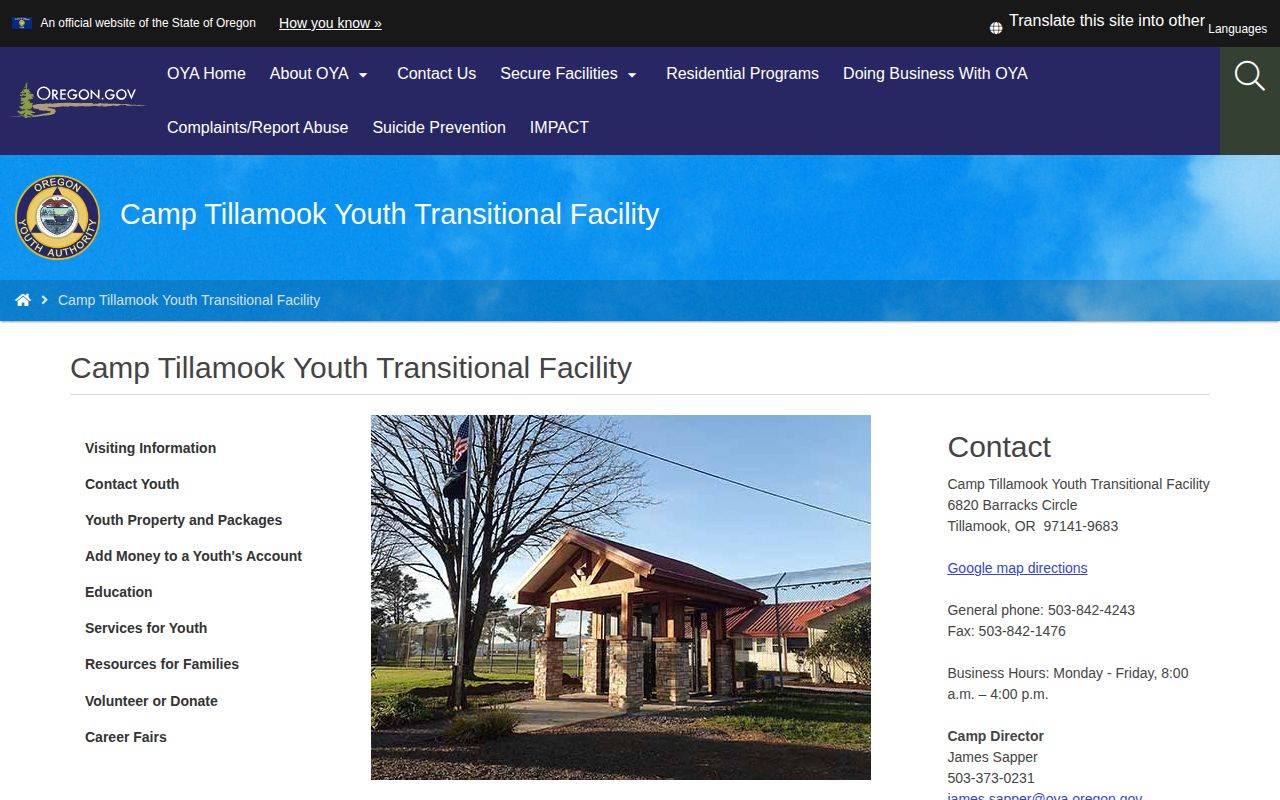
The OYA source confirms that transition services occur within a distinct secure youth facility.
Camp Tillamook Record Limits
Youth and juvenile records do not follow the same public pattern as adult jail rosters. Court records can be sealed or access-limited. Medical, victim, and case-management information may also be protected. Therefore, a caller may receive procedural help without receiving a placement or discharge detail.
VISOR collaborates with OYA and can supply some custody or supervision notices. Still, it warns that data are periodically updated and are not official records. Research did not confirm how every fully discharged OYA record appears or how long it stays visible. Use a notice to prompt an authorized OYA check, not to bypass confidentiality.
Note: Public nonappearance can result from youth privacy rules and should never be treated as proof of discharge.
Camp Tillamook Discharge Questions
A precise inquiry separates four questions. Did secure placement at Camp Tillamook end? Did another OYA facility assume custody? Did community supervision begin? Did OYA authority fully discharge? Each answer can carry a different date and may come from a different authorized record.
A court order describes judicial authority but may not record the exact moment OYA carried out a movement. OYA case records address placement and transition, subject to access limits. Juvenile parole or probation staff address supervision. The adult county jail controls none of these routine camp records.
Does leaving the camp grounds mean release? No. Approved work, education, or another controlled activity can occur while close custody continues.
Camp Tillamook Transition Record
The phrase release record can be too broad for a staged transition program. One record may document placement at Camp Tillamook. Another may address an approved community activity. A supervision record may begin later, and a discharge entry may follow after that. Request the event that answers the real question instead of assuming the camp publishes one combined certificate.
For an authorized family inquiry, useful questions include whether close custody remains in effect, whether the youth transferred to another OYA site, which officer manages a community phase, and whether a formal discharge date exists. These are questions to route to the case team. They are not promised public fields, and the answer may be limited by confidentiality.
Adult systems can create false leads here. The Tillamook County jail roster describes current adult county custody. Oregon Offender Search concerns people committed to adult DOC. Neither is a dependable historic list for Camp Tillamook. Even a court record may be restricted or may state only the legal order. OYA's authorized case channel remains the central source for the actual youth transition, while VISOR can serve as a supplemental notice tool when an eligible record is available.